1st Dialogue at the Packereigraben - Wassernetz Berlin
Dialogue at the Packereigraben, Berlin-Reinickendorf
Tuesday, 12 April 2023
Meeting point: 10 am S-Bf. Waidmannslust | Duration: 10 am - 1 pm

The report from the dialogue at Packereigraben is available here (in German)(PDF 935 KB).
We are back at the Packereigraben. What has happened so far? At our first dialogue event in summer and autumn 2022, we got a picture of the watercourse, provided information on watercourse assessment procedures and implemented the first planned enhancement measures. We installed flow deflectors and gravel to create habitats for small fish and insects, for example. In addition, we removed Japanese knotweed from the banks and planted black alder, a native and water-typical tree species.
Water Justice Manifesto - The People's Water Forum
 Indigenous Peoples, social movements and water defenders address the United Nations at the 2023 UN Water Conference to amplify the voices of the unheard and insist that the following fundamental issues be placed at the center of water policies at the global, regional, national and subnational levels:
Letter of the European Water Movement to the EU Parliamentarians about next 2023 UN Water Conference
In view of the convocation by the UN General Assembly of the Conference on the complete mid-term review of implementation of the goals fixed in the International Decade for Action “Water for a sustainable development 2018-2028” (2023 UN Water Conference), to be held in New York from the 22nd to the 24th of March 2023, we, movements, networks, NGOs, trade unions, that are members of the European Water Movement (EWM), invite the EU Parliament and all the MEPs to actively contribute and participate to the events of the aforesaid UN Water Conference.
The European Union's Department of International Relations has developed a common position paper for Member States (MS) with topics to be addressed in the interactive dialogues of the Conference. The suggested topics include governance, climate adaptation and financing.
Regarding this position paper, the European Water Movement (EWM) shares the EU stance on the necessity to implement a Human Rights-based perspective for water management and governance, ensuring the affordability of the Human Right to Water and Sanitation (HRWS) and the good ecological status of water bodies, underlining the need to improve accountability and transparency, and to regulate and control the involvement of the private sector and its risks for the HRWS guarantee.
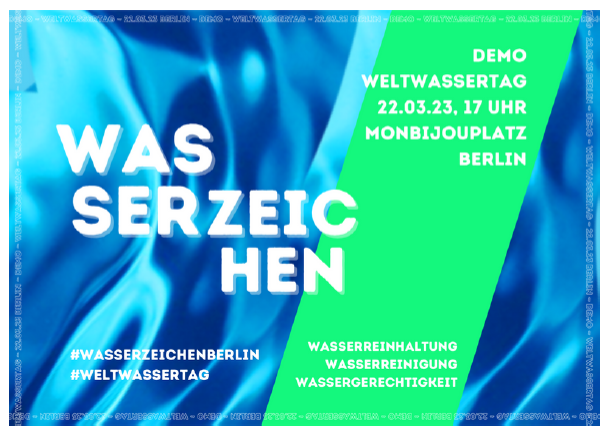
World Water Day 2023 - Watermark Demo Monbijouplatz, 22.03.2023, 5pm
WATER SIGN
World Water Day demonstration
~ For water purification, water conservation and water justice ~
When: 22 March 2023, 5:00 p.m.
Starting point: Monbijouplatz, 10178 Berlin
End point: Fluss Bad Garten, Sperlingsgasse corner Friedrichsgracht, 10178 Berlin.
We all love water. We all need water. And we all care about water. On the occasion of World Water Day and the opening of the United Nations Water Conference on 22 March, we are making a collective statement for the protection of our natural resources, the responsible use of the element of water, the cleaning and keeping clean of our natural waters, the rediscovery of our rivers as axes of life and development and the creation of equitable access to the common good of water.
Coal company LEAG avoids landmark ruling by European Court of Justice
Polluter LEAG finally pays for sulphate contamination in Frankfurt's drinking water
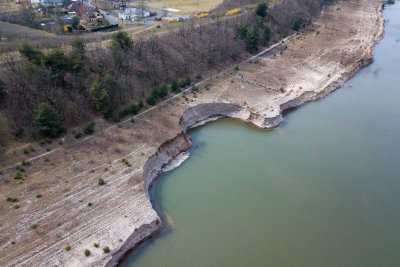 Cottbus, 28.02.2023. The environmental network GRÜNE LIGA regrets that there will be no landmark ruling by the European Court of Justice on the Cottbus opencast lake for the time to come. LEAG and water supplier FWA have apparently agreed on a payment in millions, thus ending their legal dispute. Other proceedings concerning the Cottbus-Nord opencast mine, however, remain pending before the courts. The flooding of the lake continues to be interrupted repeatedly due to a lack of water.
"It was high time that the coal company, as the polluter of the sulphate pollution, at least pays for part of the consequential costs. Unfortunately, this avoids a fundamental clarification by the European Court of Justice as to what value drinking water extraction has over mining interests. In view of the foreseeable further consequential damage from its opencast mines, LEAG obviously wanted to avoid a court clarification." René Schuster of the GRÜNE LIGA comments on the reached agreement.
